Genetics

Genetics is the branch of biology that deals with the study of heredity and its biological process. It also involves the study of genes, genomes and the cell cycle.
What is Genetics?
Genetics is termed as the study to understand the functioning of inheritance of traits from parents to offspring. The groundwork on which heredity stands is known as inheritance. It is defined as the procedure by which characteristics are handed down from one generation to the other. Gregor Johann Mendel is known as the “Father of Modern Genetics” for his discoveries on the basic principles of heredity.
Variation, as the name suggests is the amount of dissimilarity that exists between children and their parentages. It can be determined to keep in view the behaviouristic, cytological, physiological, and morphological characters of individuals fitting into similar species.
Some of the major reasons that variation are
- Genetic/Chromosomal rearrangement.
- Mutated genes due to the influence of the ecosystem.
- Crossing over.
Let us have a detailed look at genetics notes to learn about genes and the principle of inheritance.

Law of Inheritance by Gregor Mendel
Garden Pea (Pisum Sativum) was the plant that Mendel experimented on for 7 years to get to the point to propose the laws of inheritance in live creatures. Mendel carefully chose seven distinct characteristics of Pisum Sativum for the investigation concerning hybridization. Mendel used true-breeding lines i.e. those that go through constant self-pollination and display steady characteristic inheritance.
Inheritance can be defined as the process of how a child receives genetic information from the parent. The whole process of heredity is dependent upon inheritance and it is the reason that the offsprings are similar to the parents. This simply means that due to inheritance, the members of the same family possess similar characteristics.
It was only during the mid 19th century that people started to understand inheritance in a proper way. This understanding of inheritance was made possible by a scientist named Gregor Mendel, who formulated certain laws to understand inheritance known as Mendel’s laws of inheritance.
Table of Contents
- Mendel’s Laws of Inheritance
- Why was Pea Plant Selected for Mendel’s Experiments?
- Mendel’s Experiments
- Conclusions from Mendel’s Experiments
- Mendel’s laws
- Key Points on Mendel’s Laws
Mendel’s Laws of Inheritance

Between 1856-1863, Mendel conducted the hybridization experiments on the garden peas. During that period, he chose some distinct characteristics of the peas and conducted some cross-pollination/ artificial pollination on the pea lines that showed stable trait inheritance and underwent continuous self-pollination. Such pea lines are called true-breeding pea lines.
Why was Pea Plant Selected for Mendel’s Experiments?

He selected a pea plant for his experiments for the following reasons:
- The pea plant can be easily grown and maintained.
- They are naturally self-pollinating but can also be cross-pollinated.
- It is an annual plant, therefore, many generations can be studied within a short period of time.
- It has several contrasting characters.
Mendel conducted 2 main experiments to determine the laws of inheritance. These experiments were:
- Monohybrid Cross
- Dihybrid Cross
While experimenting, Mendel found that certain factors were always being transferred down to the offspring in a stable way. Those factors are now called genes i.e. genes can be called the units of inheritance.
Mendel’s Experiments
Mendel experimented on a pea plant and considered 7 main contrasting traits in the plants. Then, he conducted both experiments to determine the inheritance laws. A brief explanation of the two experiments is given below.
Monohybrid Cross
In this experiment, Mendel took two pea plants of opposite traits (one short and one tall) and crossed them. He found the first generation offspring were tall and called it F1 progeny. Then he crossed F1 progeny and obtained both tall and short plants in the ratio 3:1. To know more about this experiment, visit Monohybrid Cross – Inheritance Of One Gene.
Mendel even conducted this experiment with other contrasting traits like green peas vs yellow peas, round vs wrinkled, etc. In all the cases, he found that the results were similar. From this, he formulated the laws of Segregation And Dominance.
Dihybrid Cross
In a dihybrid cross experiment, Mendel considered two traits, each having two alleles. He crossed wrinkled-green seed and round-yellow seeds and observed that all the first generation progeny (F1 progeny) were round-yellow. This meant that dominant traits were the round shape and yellow colour.
He then self-pollinated the F1 progeny and obtained 4 different traits: round-yellow, round-green, wrinkled-yellow, and wrinkled-green seeds in the ratio 9:3:3:1.
Check Dihybrid Cross and Inheritance of Two Genes to know more about this cross.
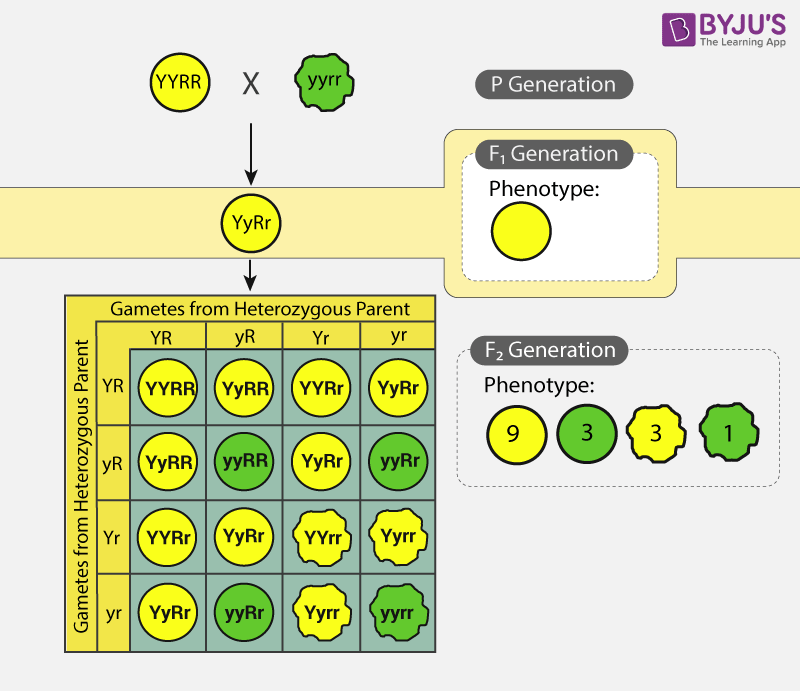
After conducting research for other traits, the results were found to be similar. From this experiment, Mendel formulated his second law of inheritance i.e. law of Independent Assortment.
Conclusions from Mendel’s Experiments
- The genetic makeup of the plant is known as the genotype. On the contrary, the physical appearance of the plant is known as phenotype.
- The genes are transferred from parents to the offspring in pairs known as alleles.
- During gametogenesis when the chromosomes are halved, there is a 50% chance of one of the two alleles to fuse with the allele of the gamete of the other parent.
- When the alleles are the same, they are known as homozygous alleles and when the alleles are different they are known as heterozygous alleles.
Mendel’s laws
The two experiments lead to the formulation of Mendel’s laws known as laws of inheritance which are:
- Law of Dominance
- Law of Segregation
- Law of Independent Assortment
Law of Dominance
This is also called Mendel’s first law of inheritance. According to the law of dominance, hybrid offspring will only inherit the dominant trait in the phenotype. The alleles that are suppressed are called the recessive traits while the alleles that determine the trait are known as the dominant traits.
Law of Segregation
The law of segregation states that during the production of gametes, two copies of each hereditary factor segregate so that offspring acquire one factor from each parent. In other words, allele (alternative form of the gene) pairs segregate during the formation of gamete and re-unite randomly during fertilization. This is also known as Mendel’s third law of inheritance.
Law of Independent Assortment
Also known as Mendel’s second law of inheritance, the law of independent assortment states that a pair of traits segregates independently of another pair during gamete formation. As the individual heredity factors assort independently, different traits get equal opportunity to occur together.
Key Points on Mendel’s Laws
- The law of inheritance was proposed by Gregor Mendel after conducting experiments on pea plants for seven years.
- Mendel’s laws of inheritance include law of dominance, law of segregation and law of independent assortment.
- The law of segregation states that every individual possesses two alleles and only one allele is passed on to the offspring.
- The law of independent assortment states that the inheritance of one pair of genes is independent of inheritance of another pair.
Principles of Inheritance
When Mendel observed the monohybrid cross he proposed two laws of inheritance-
Law of Dominance – Distinct elements termed as factors control the characteristics. These factors at all times exist as a couple. One of the constituent genes of the couple dominates over the former.
Law of Segregation – Alleles don’t blend and the two characteristics are recuperated all through the gamete formation (in the F2 generation). The characters are apart from each other and pass on to diverse gametes. Comparable types of gametes are produced by Homozygous and Heterozygous produces diverse sorts of a gamete with varied characteristics.
What is Heredity?
In Biology, heredity is the term used for transmission of the traits from one generation to the next generation. It is due to heredity that the offsprings look similar to their parents. It also explains why dogs always give birth to puppies and never to kittens. The process of heredity is universal among all living organisms. Genetic variation refers to the variation in a population or species. Genetics is the study of heredity and variation in living organisms.
Transmission genetics and cytogenetics have helped scientists investigate the biological basis of heredity. In transmission genetics, organisms are crossed to study the inheritance pattern in offsprings. Cytological techniques help in understanding cellular reproduction. With the advancement of molecular biology and its tools and techniques, geneticists are able to understand the genetic basis of the inheritance of traits and variations present in various organisms.

Genetics
Genetics is the science which deals with the mechanisms responsible for similarities and differences among closely related species. The term ‘genetic’ was coined by William Bateson in 1905. It is derived from the Greek word ‘genesis’ meaning grow into or to become. So, genetics is the study of heredity and hereditary variations, it is the study of the transmission of body features: i.e., similarities and difference, from parents to offspring and the laws related to this transmission.
Variation
Any differences present between individuals of any species, caused either by genetic difference or by the effect of environmental factors, is called variation. Variation can be shown in physical appearance, metabolism, behaviour, learning and mental ability, and other obvious characters.
Types of Variation
Variations can be categorised into two types:
Genotypic variations: – Genotypic variations refer to the differences in the genome, it may be due to structure or number of chromosomes present in the cells or difference in the genetic constituents of the chromosomes. Skin, hair, eye colour, height are some of the genotypic variations in animals. A variation can only be confirmed as genotypic by doing cross-breeding experiments.
Somatic variations: – Somatic variations are not hereditary. These are not due to changes in the alleles or chromosomes. These are due to various factors such as nutrition, climate and due to other social interactions.

Heredity
Heredity refers to the transmission of traits from parents to offsprings. Heredity is responsible for the resemblance among individuals of the same species.
Mendel’s Laws of Heredity
Gregor Johann Mendel is known as the father of genetics. He was the first to show the inheritance pattern of traits from one generation to the next generation. He did his research on the garden pea, Pisum sativum. He selected 7 pairs of contrasting traits like the red and yellow colour of the pod, round and wrinkled seeds, tall and short plants, etc. and crossbred the plants to understand their inheritance pattern. Mendel gave three fundamental laws of inheritance.
- Law of dominance: States that in the heterozygous condition of the genotype for a pair of alleles, the alleles which express itself phenotypically is dominant and the one which can’t express is recessive.
- Law of segregation: States that although the alleles of a character remain together for a long time, they do not mix with each other and separate at the time of gametogenesis so that each gamete receives only one allele of a trait, which is either dominant or recessive. When tall pea plants of the F1 generation (obtained by crossing homozygous tall and dwarf pea plants), are self-fertilised, we get tall and dwarf plants in the ratio of 3:1.
- Law of Independent assortment: States that when more than a pair of characters are taken into consideration, alleles of a character can undergo any sort of combination to give rise to a phenotype differing from both the parents.
Notations used in Breeding Experiments
The dominant trait – Upper case letter, e.g. Tallness is represented by ‘T’
The recessive trait – Lower case letter, e.g. Dwarfness by ‘t’
Homozygous – A pair of same alleles, e.g. TT (homozygous dominant) or tt (homozygous recessive)
Heterozygous – Having different alleles of a trait, e.g. Tt
Incomplete Dominance
It is the discovery that was done after Mendel’s work. Incomplete dominance is the situation in which both the alleles do not display a dominant trait resulting in a fine combination or a midway amid the characteristics of the alleles.
Codominance
When two alleles lack the dominant-recessive association and thus the duo affects the creature together.
Law of Independent Assortment
The separation of one set of characteristics is autonomous of the other set of characters when they are pooled in a hybrid.
The Chromosomal Theory of Inheritance
Both genes and chromosomes exist in sets of two. The homologous chromosome contains the two alleles of a gene pair in the homologous sites. The coupling and split of a set of chromosomes will cause a split in the set of genes (factor) they carry. This united knowledge is termed the Chromosomal Theory of Inheritance.

Sex Determination
A particular nuclear arrangement was perceived by Henking. He perceived that this particular nuclear arrangement was found in only fifty per cent of sperms. He termed this body as x. Later, it was observed that the ova which only obtained the X chromosome matured and were born as females and those that didn’t receive only X chromosomes were born as males. Thus, the X- chromosome was termed a sex chromosome and the remaining ones were termed autosomes.
The occurrence due to which a modification in DNA happens and causes a variation in the phenotype and genotype of a creature is termed a Mutation.
There are two different types of sexes, that participate in sexual reproduction. So it is natural to find it confounding as from which sex the baby inherits, that results in the sex of the child. There are several other procedures followed to determine the sex of a newborn baby. Based on the environmental signals the sex of a baby can be determined. In a few animal species, temperature plays a major role in sex determination. In other animals, like snails, it is possible to change sex as they are not genetically processed. In human beings, the sex of an individual is genetically determined. In other words, the genes which are inherited from their parents decide the sex of the child.
Determining the Sex
To understand how the determination of sex happens, we need to know the following process.
- Humans have 23 pairs of chromosomes. Out of these 23 pairs, 22 pairs are Autosomes and only one pair is the ‘Sex Chromosome’, which actively takes part in the process of sex determination.
- Both males and females carry two sets of sex chromosome.
- Male has one X and one Y (XY) sex chromosome in which both are active
- Female has both X (XX) sex chromosome in which one is active.
- The XY sex-determination system is found in humans, mammals, in some insects, and in few plant species.
- All children will inherit an X chromosome from their mother, despite whether they are a boy or girl. Thus, the sex of the children will be determined by the type of chromosome inherited from their father.
- A child who inherits Y chromosome will be a boy and who inherits X chromosome will be a girl.
- A male semen’s holds approximately 50 percent of Y sperm cells and other 50 percent of X sperm cells. Therefore, there are possibilities that men have three or more children of a single-gender.

Genetic Disorders
Disorders of a Mendelian nature include:
- Haemophilia.
- Sickle Cell Anaemia.
- Phenylketonuria.
Disorders of a chromosomal nature include:
- Down’s syndrome.
- Klinefelter’s Syndrome.
- Turners Syndrome.
Chromosomal abnormalities or chromosomal disorders are the type of genetic disorders caused due to the change in one or many chromosomes or the abnormal arrangement of the chromosomes. There are different types of chromosomal abnormalities that are as follows:
- Aneuploidy – It is a condition in which there is a loss or gain of chromosomes due to abnormal segregation of genes during cell division. It can lead to monosomy, trisomy, tetrasomy, etc.
- Polyploidy – It is a condition in which the count of the entire set of chromosomes increases due to the failure of cytokinesis in cell division. It is mostly observed in plants.
In humans, when there is an extra copy of a chromosome in one of the pairs, it is called trisomy and when one of the chromosomes from the pair is lacking, it is called monosomy.
Examples of Chromosomal Abnormalities
The most common examples of these chromosomal disorders are Down’s syndrome, Klinefelter syndrome, and Turner syndrome.
 A kid suffering from Down Syndrome
Let us look at these three examples in detail:
- Down syndrome: This syndrome is a type of trisomy as there is an extra copy of chromosome 21. It is named after the person who discovered this chromosomal disorder – Langdon Down. The symptoms in a person include the following:
- The person is short and has a small and round head
- Physical and mental development is retarded
- Furrowed tongue and partially open mouth,
- Broad palm
- Klinefelter syndrome: This genetic disorder arises due to the presence of an additional X chromosome in males. Thus, resulting in a chromosome count of 47 (44 + XXY) instead of 46. The symptoms include:
- Such a person has a masculine physique but has feminine development like the development of breasts
- Such individuals are sterile, i.e.; they cannot reproduce
- Turner syndrome: Unlike Klinefelter syndrome, in this chromosomal disorder there is the absence of one X chromosome in females. Hence, decreasing the chromosomes count to 45 (44 + X0). The symptoms include the following:
- Such females are sterile
- Have rudimentary ovaries and there is the absence of secondary sexual characters.
References
- ^ Griffiths AJ, Miller JH, Suzuki DT, Lewontin RC, Gelbart, eds. (2000). "Genetics and the Organism: Introduction". An Introduction to Genetic Analysis (7th ed.). New York: W.H. Freeman. ISBN 978-0-7167-3520-5.
- ^ Hartl D, Jones E (2005)
- ^ "the definition of genetics". www.dictionary.com. Retrieved 25 October 2018.
- ^ "Genetikos (γενετ-ικός)". Henry George Liddell, Robert Scott, A Greek-English Lexicon. Perseus Digital Library, Tufts University. Archived from the original on 15 June 2010. Retrieved 20 February 2012.
- ^ "Genesis (γένεσις)". Henry George Liddell, Robert Scott, A Greek-English Lexicon. Perseus Digital Library, Tufts University. Archived from the original on 15 June 2010. Retrieved 20 February 2012.
- ^ "Genetic". Online Etymology Dictionary. Archived from the original on 23 August 2011. Retrieved 20 February 2012.
- ^ Science: The Definitive Visual Guide. Penguin. 2009. p. 362. ISBN 978-0-7566-6490-9.
- ^ Poczai P, Santiago-Blay JA (July 2022). "Themes of Biological Inheritance in Early Nineteenth Century Sheep Breeding as Revealed by J. M. Ehrenfels". Genes. 13 (8): 1311. doi:10.3390/genes13081311. PMC 9332421. PMID 35893050.
Comments
Post a Comment